
Guide · Updated
Why Your Amazon Sales Grow While Your Own Website Doesn’t
For a brand built in retail, Amazon sales usually grow on their own, because shoppers who already know the brand search for it on Amazon. Your own website’s sales stay flat, because it was never set up to catch that same demand (even though an order on your website usually keeps far more profit than the same order on Amazon.) It is one of the most common causes of what Good Monster calls the Ecommerce Gap: the distance between the demand a CPG or retail brand creates and the revenue it actually captures.
Written by John Timmerman, Founder and CEO of Good Monster, who has run the company for 14 years. Good Monster has worked with 150+ consumer brands, including Ghirardelli, Beaba and Radius.
Why this happens
Four things tend to be true at the same time for brands in this position.
Amazon collects demand your brand already earned.
Shelf presence, word of mouth, and advertising make people look for your product by name. Many of them type that name into Amazon because the shipping is fast and they trust it. Amazon did not create that demand. It collected it, and nobody on your team had to do much for that to happen.
Amazon is where people go to buy.
Shoppers use Amazon like a search engine. The reviews are already there, shipping is fast, and checkout only takes one click. Your brand’s own website has to work harder to earn the same level of trust consumers have in Amazon.
Nobody decided the channel mix.
Amazon was rarely the primary plan. It grew, it looked fine, and the team kept moving. For years the next growth dollar went to the channel that was already growing, which is also the channel that keeps the least margin.
The website was built as a brochure.
The dot-com often runs on a basic Shopify store with few reasons to buy now, no bundles, no subscription option, and an email list that is under-used. Because of all of this, the site converts at only 1 to 1.5 percent, so most of the people who arrive leave without buying.
How This Shows in Search
Profit margin on Amazon vs. your own website
The easiest way to see the cost is to start with $100 of sales in each channel and take out each cost. These figures are typical for a brand like this. Your own numbers may differ.
| Start with $100 of sales | On Amazon | On your own website |
|---|---|---|
| You sell | $100 | $100 |
| Referral fee and fulfillment | − $27 to $33 | − $3 (payment processing) |
| Shipping | Included in fulfillment | − $5 |
| Returns and reimbursements | − $5 | − $5 |
| Advertising | − $18 (a typical ad cost of sales) | − $10 (branded search, email and retargeting to shoppers who already know you) |
| Product cost | − $35 | − $35 |
| What you keep | $9 to $15 | $42 |
Amazon fee figures follow Amazon’s published 2026 referral and FBA fees, including the 3.5% fuel and logistics surcharge on FBA fulfillment fees added on April 17, 2026. See Amazon’s selling fees, its 2026 fee update and the surcharge notice.
With advertising counted on both sides, the difference is 27 to 33 percentage points, or about 30. That holds for shoppers who already know you: repeat buyers and people searching your brand by name, who cost little to bring to your site. For brand-new customers, the cost of getting them there takes a bigger share.
Take a brand that sells $4 million a year on Amazon. If 20 percent of those orders, or $800,000, came from repeat buyers and brand searchers who bought on the brand’s own website instead, a 30-point difference means about $240,000 more in contribution margin. These would be the same customers buying the same products, with only the channel changed. Your finance team can check every line against your Amazon statements and your store reports.
Want your real number instead of an example?
The full Ecommerce Gap Analysis calculates it from your own Amazon, store and ad data. Book a call to start it.
Signs this is your brand
- Retail is steady, and Amazon grew without a plan behind it.
- Amazon growth has slowed after years of growing by itself.
- Your brand gets more than 1,000 branded searches a month, and nobody is actively improving your Amazon setup.
- Nobody has calculated Amazon profit after fees and advertising, or the number came out worse than expected.
- Your website converts at around one percent and has no bundles or subscription.
- One person manages ecommerce across every channel and is stretched thin.
How to move Amazon buyers to your own site
The goal is not to leave Amazon. It is to win the shoppers who already know you before they default to Amazon.
- Own your branded search. Make sure your own site, not your Amazon listing, is the first result when someone searches your brand, and run a small branded search campaign to protect that spot.
- Give a reason to buy direct. Bundles, subscriptions, variety packs and sizes you don’t sell on Amazon give shoppers a reason to choose your site.
- Fix the checkout. Show reviews near the buy button, offer fast checkout like Shop Pay, and set a free-shipping threshold your bundles clear.
- Point your own marketing at your site. Social posts, creator content, email and in-store displays should send people to your site, not to Amazon.
- Keep the customer after the first order. Collect email and text sign-ups at checkout and send to that list, so the second order happens on your site too.
One thing not to do: Amazon does not allow inserts or messages that send its buyers to purchase somewhere else. Do this work before the shopper reaches Amazon.
Three numbers to look at first
- Your Amazon contribution margin after fees, returns, and advertising.
- Where your branded searches end up: your own site, Amazon, or a retailer.
- Your own site’s conversion rate and average order value.
Don’t want to crunch the numbers yourself? Our free Ecommerce Gap Analysis is a 90-second scan: you type in your website address, and it reads public data to estimate how much of the demand you created is ending up somewhere else. No revenue inputs and no email required. You can read how we define the Ecommerce Gap on its own page.
What changes when the channel mix is managed
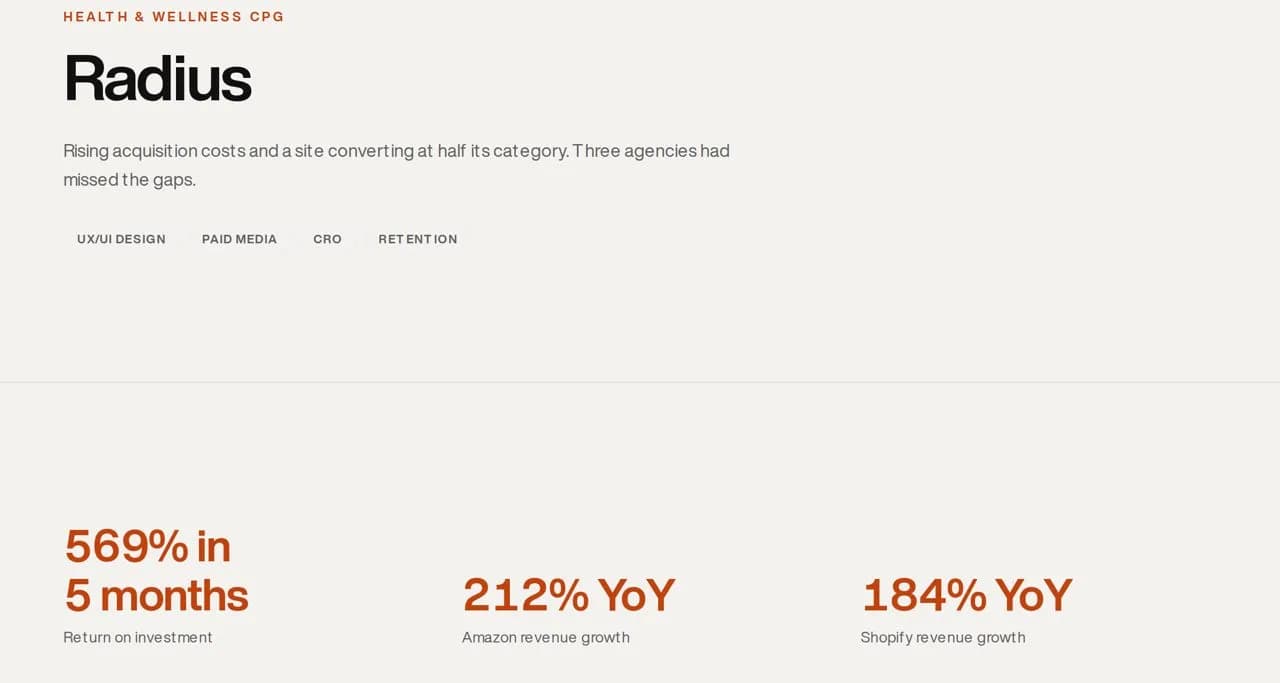
Radius grew Amazon revenue 212 percent and Shopify revenue 184 percent year over year, and returned 569 percent on its investment in 5 months. Both channels grew together, so the website was not left behind while Amazon took the growth. On the retail side, paid media for Beaba lifted Target store sales 23 percent. Both results are on the case studies page.
This work sits inside ShelfProof by Good Monster, our program for protecting the work it took to get your product on the shelf, in stores and online. ShelfProof Ecommerce has creators buy your product on the channel you choose, including your own site, and turns their videos into ads.
Find out where your demand is going
Enter your website for a free first estimate in about 90 seconds, or book the full analysis for the real number from your own data.
Questions about Amazon and your own website
Shoppers who already know your brand search for it on Amazon because it is fast and trusted. That means Amazon collects demand your shelf presence and word of mouth already created. Your own website usually was not set up to catch that demand, so it stays flat.
It is a problem when you do not know what you earn on those sales. An order on Amazon often keeps much less margin than the same order on your own site, and the customer relationship stays with Amazon. Once you know the numbers, you can decide which orders to keep there and which to move.
It depends on your costs. In a typical example, $100 sold on Amazon leaves about $9 to $15 after fees, returns, advertising, and product cost. The same $100 sold on a brand’s own site leaves about $42 after payment processing, shipping, returns, advertising to shoppers who already know the brand, and product cost. That is a difference of about 30 percentage points. Your figures will differ, so the first step is to calculate them.
No. Amazon is a useful channel and shoppers expect to find you there. The better question is which orders can move to your own site, for example repeat buyers and people who searched for your brand by name.
A useful threshold is at least 1,000 branded searches a month. Above that, the demand is there, and a brand that is not actively improving its Amazon listings, ads and reviews is losing those sales to competitors.
Reach them before they default to Amazon. Make your site the first result for your brand name, give a reason to buy direct such as bundles or a subscription, make checkout fast, point your social, creator and email marketing at your site, and collect email and text sign-ups so the next order happens there too.
No. Amazon does not allow inserts or messages that direct its buyers to purchase somewhere else. Win those shoppers earlier instead, through branded search, in-store displays, your social and creator content, and a reason to buy direct.
Start with the three numbers above. The free Ecommerce Gap Analysis gives you a first estimate from public data in about 90 seconds. For the full number, book a call: the full analysis uses your own Amazon, store and ad data.